
Wednesday, 25 January 2012

Monday, 23 January 2012
Saturday, 14 January 2012
COMPONENTS OF THE COFFEE ECOSYSTEM
The coffee ecosphere consists of all living things, all inorganic materials and physical forces interacting with one another. Understanding the coffee ecosphere aids in unraveling the energy flows, deciphering the interactions between living things and the environment, the transfer of food, the flow of energy and the exchange of inorganic nutrients and organic compounds. The coffee grid in turn depends upon the delicate balance of ecological processes for the fulfillment of its needs. The coffee ecosystem closely interacts with the BIOTIC (LIVING) & the ABIOTIC (NON-LIVING) environment. The relationships between the different factors are so smooth and often so subtle that seldom we are aware of the immense structural and functional complexities involved. Within the coffee mountain there is a great diversity in the types of ecosystems because of the change in elevation within a single zone. The energy balance within each system, ultimately determines the health of the coffee forest. The dominant energy which enters the coffee ecosystem is mainly in the form of sunlight and is used by photosynthetic organisms in the synthesis of organic matter. The energy and the nutrients obtained from the nutrient pool of the soil move from producers to herbivores. A part of this energy is dissipated by the organisms during respiration and the rest made available to herbivores, which are animals that consume the photosynthesizers. The herbivores in turn make use of this energy in the build up of cellular constituents and make way for the carnivores. The carnivores use the herbivores as their primary energy source and the food chain continues with one carnivore eating the other. It is of paramount importance to remember that every step is characterized by a chain of events leading to energy loss in the form of heat. Death or destruction of flora or fauna results in the establishment of DECOMPOSERS. The decomposers act on the litter, decaying plants and animals and return the minerals to the nutrient pool. The primary decomposers are the microorganisms. Microorganisms utilize energy released by plants and animals in the form of excretory products.

BIOTIC COMPONENTS: Producers, Consumers, Decomposers
ABIOTIC COMPONENTS: ENVIRONMENT, INORGANIC ELEMENTS, CARBON, OXYGEN, HYDROGEN, WATER, POSPHATES, CARBONATES Minerals, Liquids, Gases, PHYSICAL FACTORS-MOISTURE, AIR CURRENTS, LIGHT.ETC. ORGANIC: Proteins, Carbohydrates, lipids, etc.
MACROCONSUMERS OR PHAGOTROPHS: Heterotrophic organisms mainly animals. Organisms which obtain their energy from sources other than themselves, indirectly or directly.MICROCONSUMERS: Chiefly Bacteria, fungi. Actinomycetes.They break complex organic molecules into simpler compounds for producers.
PRODUCERS OR AUTOTROPHS: These are the green plants with the help of chlorophyll prepare their own food. Since, green plants or producers convert solar energy into chemical energy, they are sometimes referred to as transducers of energy.

CONSUMERS
The physical and chemical environment inside the coffee mountain plays an important role in the distribution of energy levels. Within the boundaries of the coffee mountain biotic partners interact and carry out their activities significantly modifying the characteristics of the mountain. Only a small fraction of the solar energy (< 10 % of the total solar energy falling upon the coffee forest is used by the first tropic level. This chemical energy stored in the plant tissues is used up by the plant to carry out its physiological activities and a part of the energy is transferred to the next tropic level, namely consumers, also referred to as HETEROTROPHS. Along the transformation path, there is a loss of certain amount of energy. Further, the flow of energy is always unidirectional and gradually tapers. Useful energy level steadily declines from one tropic level to the other.
ECOLOGICAL PYRAMID
An inside view of the coffee mountain reveals a highly organized and intelligent ecological pyramid. First come the producers (Tall evergreen trees, herbs, shrubs, climbers,) and then a regular decrease in the energy, biomass and number of organisms occupying a tropic level. The pyramid starts with a broad base and ends tapering at the apex.

- PYRAMID OF NUMBERS: It indicates the numerical relationship between the different tropic levels of the food chain.
- PYRAMID OF ENERGY: Explains the movement of energy flow at each tropic level as well as the role played by different organisms in the transfer of energy. Energy pyramids are always slopping. Greater amount of energy is available at the producer level and gradually decreases by the time it reaches the primary consumer level. In turn Energy production of the primary consumers is greater than that of the secondary consumers.
- PYRAMID OF BIOMASS: Represents the total dry matter present in the ecosystem at any one given point of time.
The energy sources within the coffee mountain are highly variable depending on the seasons. Some nutrients are available only for short periods of time because of the rapid colonization and consumption of microorganisms and in some cases depending on the leaf shedding there is an excess of nutrients on the floor of the forest. The best part of the energy equation is that microorganisms have evolved highly sophisticated regulatory mechanisms to make use of the available energy resources. This has a tremendous bearing on the quantitative yield and qualitative yield of coffee.

Depending on the elevation, rainfall, temperature and other related physical factors the coffee mountain is organized into a large number of intersecting food WEBS. This complex food web consists of diverse number of species, the populations of which have reached equilibrium in terms of rate of multiplication and destruction. Any sudden or drastic change in equilibrium results in the break down of the natural rhythm of the ecosystems.
JOE'S SUSTAINABLE FORMULA: THE KIREHULLY EXPERIMENT
Based on our very own experiments as well as collecting data from fellow farmers we have arrived at a few significant conclusions which will help coffee farmer's world wide in maintaining the productivity and a sound ecological balance within their coffee farm.
Productivity is generally defined in terms of the amount of dry matter accumulated within a specified period, expressed in grams/m?/day. The productivity of green plants is known as primary productivity and that of consumers and decomposers as secondary productivity.
GROSS PRODUCTIVITY: It is a reflection of the sum total of organic compounds accumulated, inclusive of the amount used in respiration by the plants during which measurements are made.
NET PRODUCTIVITY: Refers to the amount of organic compounds stored by the plants in their tissues.
- For every ton of raw coffee (Arabica) sold, the coffee farmer needs to externally add up to two tons of compost. In case of Robusta coffee, the required compost is one and a half tons.
- For every ton of anticipated coffee, two and a half tons of compost should be added in the available form.
- The raw materials used for compost should have a low carbon nitrogen ratio and it is preferable to use Sheep, poultry and cattle manure mixed along with raw neem seeds, coffee pulp and green leaves of erythrina indica and glyrecedia immaculate.
- Timing of application of compost is very important. Check other articles (Fine art of composting, organic manures).
- It is not advisable to only use cattle manure as a base for compost. Every compost pit should be lined with soil from fertile cradle pits or water trenches to boost the native micro flora.
- In case of ROBUSTA, with increase in age of plants, the application of nitrogenous fertilizers should be reduced.
HOMEOSTASIS: AND CYBERNETICS

HOMEO=SAME, STASIS=STANDING. To a considerable extent, coffee ecosystems are self regulating entities that have a high degree of equilibrium or homeostasis. The environment and the organisms are both products of a continuous process of change. Cybernetics refers to undesirable man made changes in trying to disturb the natural controls. For e.g. In spite of dramatic changes in the weather due to depleting forest cover or sudden rise in hydrogen ion concentration, due to excessive application of nitrate fertilizers, the coffee bush as well as the surrounding flora and fauna try to adjust their physiological activity by switching on and switching off a few essential genetic components so as to not be affected by the sudden change. However, if the changes persist over an extended period of time, then there is every likelihood in the collapse of the biotic system.
CONCLUSION
Evolutionary biologists have time and again arrived at one scientific truth that has great relevance for shade grown Indian coffee plantations. They are of the opinion that it is not necessarily the strongest or the largest species that survive, but the one's most responsive to change. However, it is to be observed that these changes should be gradual and a product of nature rather than man made, sudden and dramatic. When the changes are slow, it gives adequate time and ability for the biotic partners to adapt and transform to survive the changing times and thrive. Nature is an amazing survivor under such circumstances.

Managing coffee plantations has been a deeply enriching experience for the two of us. Our observations for the past 20 years point out that the coffee forests possess the most luxuriant vegetation of all biomes and there is a strong ASSOCIATIVE INFLUENCE among various biotic components inside the coffee mountain. The coffee ecosystem is mutually inter connected and interrelated. A few factors like global warming, geo chemical changes, destruction of forests, commercial logging, toxic levels of pesticide residues can drastically imbalance or upset the food supply chain resulting in the break down of food webs. The reason may be attributed to the fact that we have not been able to understand the delicate and orderly balance that exists in the natural ecosystems. One has to bear in mind that all food chains are cyclic in nature.
Tim Radford reports in the "GUARDIAN" under the title BLUE PLANET'S RED BALANCE SHEET that the human race is living beyond its means. A report backed by 1360 scientists from 95 countries-some of them world leaders in their fields warns that almost two thirds of the natural machinery that supports life on earth is being degraded by human pressure. The wetlands, forests, savannahs, estuaries, coastal fisheries and other habitats that recycle air, water and nutrients for all living creatures are being irretrievably damaged. In effect, one species is now a hazard to the other 10 million or so on the planet, and to itself. Human activity is putting such a strain on the natural functions of earth that the ability of the planet's ecosystems to sustain future generations can no longer be taken for granted. The report prepared in Washington under the supervision of a board chaired by Robert Watson, the British born chief scientist at the world bank and a former scientific adviser to the White house, will be launched soon at the Royal Society in London. It warns that because of human demand for food, fresh water, timber, fiber and fuel, more land has been claimed for agriculture in the last 60 years than in the 18th and 19th centuries combined. An estimated 24% of the earth's land surface is now cultivated.
One burning question that remains in our mind is that at the present rate of destruction whether coffee mountains will remain without biodiversity? Coffee farmer's world wide should be cautious in destroying forest relationships.
In the new world order, the temptation of using chemicals and pesticides is even greater. This practice can contaminate food webs. At each level of the food chain, chemicals and heavy metals can go on concentrating and finally get embedded in the human body as a result of BIOMAGNIFICATION. This can result in dire consequences for future generations. The ultimate aim of technology should be in preserving nature.

Everything that man has made in this world is surpassed by nature. We need to focus on the small details in order to better appreciate the larger spectrum. This will enable us to be conscience to the many dimensions of our existence and treat the resources of the mountain with respect. A sustainable system empowers coffee farmers to build better lives. It is our obligation to understand that in nature's shadow we all co exist.
FOOD CHAINS FOLLOW A SINGLE PATH AS ANIMALS EAT EACH OTHER.
EXAMPLE:
FOOD WEBS SHOW HOW PLANTS & ANIMALS ARE INTERCONNECTED BY DIFFERENT PATHS.
EXAMPLE:
EXAMPLE:
- THE SUN provides food for GRASS
- The GRASS is eaten by a GRASSHOPPER
- The GRASSHOPPER is eaten by a FROG
- The FROG is eaten by a SNAKE
- The SNAKE is eaten by a HAWK.
EXAMPLE:
- TREES produce ACORNS which act as food for many MICE and INSECTS.
- Because there are many MICE, WEASELS and SNAKES have food.
- The insects and the acorns also attract BIRDS, SKUNKS, and OPOSSUMS.
- With the SKUNKS, OPPOSUMS, WEASELS and MICE around, HAWKS, FOXES, and OWLS can find food.
- They are all connected! Like a spiders web, if one part is removed, it can affect the whole web.
Ecosystem
Definition
noun, plural: ecosystems
A system that includes all living organisms (biotic factors) in an area as well as its physical environment(abiotic factors) functioning together as a unit.
Supplement
An ecosystem is made up of plants, animals, microorganisms, soil, rocks, minerals, water sources and the local atmosphere interacting with one another.
Word origin: coined in 1930 by Roy Clapham, to denote the physical and biological components of an environment considered in relation to each other as a unit.
Related phrases: ecosystem model, ecosystem ecology, ecosystem diversity.
See also: biotic factor, abiotic factor, ecology.
Abiotic Components
These include the non-living, physico - chemical factors such as air, water, soil and the basic elements and compounds of the environment.
Abiotic factors are broadly classified under three categories.
Climatic factors which include the climatic regime and physical factors of the environment like light, humidity, atmospheric temperature, wind, etc.
Edaphic factors which are related to the structure and composition of soil including its physical and chemical properties, like soil and its types, soil profile, minerals, organic matter, soil water, soil organisms.
Inorganic substances like water, carbon, sulphur, nitrogen, phosphorus and so on. Organic substances like proteins, lipids, carbohydrates, humic substances etc.
Biotic Components
It comprises the living part of the environment, which includes the association of a number of interrelated populations belonging to different species in a common environment.
The populations are that of animal community, plant community and microbial community.
Biotic community is distinguished into autotrophs, heterotrophs and saprotrophs.
Autotrophs (Gr: auto - self, trophos - feeder) are also called producers, convertors or transducers.
These are photosynthetic plants, generally chlorophyll bearing, which synthesize high-energy complex organic compounds (food) from inorganic raw materials with the help of sunlight, and the process is referred as photosynthesis.
Autortophs form the basis of any biotic system.
In terrestrial ecosystems, the autotrophs are mainly the rooted plants.
In aquatic ecosystems, floating plants called phytoplankton and shallow water rooted plants called macrophytes are the dominant producers.
Heterotrophs (Gr: heteros - other; trophs - feeder) are called consumers, which are generally animals feeding on other organisms.
Consumer's also referred as phagotrophs (phago - to ingest or swallow) or macroconsumers are mainly herbivores and carnivores.
Herbivores are referred as First order consumers or primary consumers, as they feed directly on plants.
For e.g., Terrestrial ecosystem consumers like cattle, deer, rabbit, grass hopper, etc.
Aquatic ecosystem consumers like protozoans, crustaceans, etc.
Carnivores are animals, which feed or prey upon other animals.
Primary carnivores or Second order consumers include the animals which feed on the herbivorous animals.
For e.g., fox, frog, predatory birds, smaller fishes, snakes, etc.
Secondary carnivores or Third order consumers include the animals, which feed on the primary carnivores.
For e.g., wolf, peacock, owl, etc.
Secondary carnivores are preyed upon by some larger carnivores.
Tertiary carnivores or Quaternary consumers include the animals, which feed on the secondary carnivores.
For e.g., lion, tiger, etc.
These are not eaten by any other animals.
The larger carnivores, which cannot be preyed upon further are called top carnivores.
Decomposers do not ingest their food. Instead they secrete digestive enzymes into the dead and decaying plant and animal remains to digest the organic material. Enzymes act upon the complex organic compounds of the dead matter.
Decomposers absorb a part of the decomposition products for their own nourishment. The remaining substances are added as minerals to the substratum (mineralisation).
Released minerals are reused (utilised) as nutrients by the plants (producers).
Biotic and Abiotic Factors
Biotic and abiotic factors are interrelated. If one factor is changed or removed, it impacts the availability of other resources within the system.
Biotic FactorsBiotic, meaning of or related to life, are living factors. Plants, animals, fungi, protist and bacteria are all biotic or living factors.
Abiotic Factors
Abiotic, meaning not alive, are nonliving factors that affect living organisms. Environmental factors such habitat (pond, lake, ocean, desert, mountain) or weather such as temperature, cloud cover, rain, snow, hurricanes, etc. are abiotic factors.
Abiotic, meaning not alive, are nonliving factors that affect living organisms. Environmental factors such habitat (pond, lake, ocean, desert, mountain) or weather such as temperature, cloud cover, rain, snow, hurricanes, etc. are abiotic factors.
A System
Biotic and abiotic factors combine to create a system or more precisely, an ecosystem. An ecosystem is a community of living and nonliving things considered as a unit.
Biotic and abiotic factors combine to create a system or more precisely, an ecosystem. An ecosystem is a community of living and nonliving things considered as a unit.
The Impact of Changing Factors
If a single factor is changed, perhaps by pollution or natural phenomenon, the whole system could be altered. For example, humans can alter environments through farming or irrigating. While we usually cannot see what we are doing to various ecosytems, the impact is being felt all over. For example, acid rain in certain regions has resulted in the decline of fish population.
If a single factor is changed, perhaps by pollution or natural phenomenon, the whole system could be altered. For example, humans can alter environments through farming or irrigating. While we usually cannot see what we are doing to various ecosytems, the impact is being felt all over. For example, acid rain in certain regions has resulted in the decline of fish population.
Abiotic and Biotic Factors
Abiotic factors are essentially non-living components that effect the living organisms of the freshwater community.
When an ecosystem is barren and unoccupied, new organisms colonising the environment rely on favourable environmental conditions in the area to allow them to successfully live and reproduce.
These environmental factors are abiotic factors. When a variety of species are present in such an ecosystem, the consequent actions of these species can affect the lives of fellow species in the area, these factors are deemed biotic factors.
This page will go into the abiotic factors of the freshwater environment which determine what sort of life would be suited to living (and adapting) to the conditions of the ecosystem.
As described in previous pages, the light from the sun is a major constituent of a freshwater ecosystem, providing light for the primary producers, plants. There are many factors which can affect the intensity and length of time that the ecosystem is exposed to sunlight;
- Aspect - The angle of incidence at which light strikes the surface of the water. During the day when the sun is high in the sky, more light can be absorbed into the water due to the directness of the light. At sunset, light strikes the water surface more acutely, and less water is absorbed. The aspect of the sun during times of the day will vary depending on the time of the year.
- Cloud Cover - The cloud cover of an area will inevitably affect intensity and length of time that light strikes the water of a freshwater ecosystem. Species of plants rely on a critical period of time where they receive light for photosynthesis.
- Season - The 4 seasons in an ecosystem are very different, and this is because less light and heat is available from the sun in Winter and vice versa for Summer, therefore these varying conditions will affect which organisms are suited to them.
- Location - The extreme latitudes receive 6 months of sunlight and 6 months of darkness, while the equator receives roughly 12 hours of sunlight and darkness each day. This sort of variance greatly affects what type of organisms would occupy freshwater ecosystems due to these differences.
- Altitude - For every one thousand metres above sea level, average temperature drops by one degree Celsius. Altitude will also affect the aspect of which sunlight hits the freshwater ecosystem, therefore playing a part on which organisms will occupy it.
As you can see, many abiotic factors can play a part in determining the end product, which organisms live and succeed in the freshwater ecosystem. The sun provides light for photosynthesis, but also provides heat giving a suitable temperature for organisms to thrive in. The temperature of a freshwater environment can directly affect the environment as a whole and the organisms that occupy it.
Enzymes operate best at an optimum temperature, and any deviation from this temperature 'norm' will result in below optimum respiration in the organism. All aquatic life are ectotherms, meaning their body temperature varies directly with its environments.
Temperature affects the density of substances, and changes in the density of water means more or less resistance for animals who are travelling in the freshwater environment.
The next page will continue to look at how these abiotic factors affect the way in which organisms operate in the freshwater ecosystem. The above examples of abiotic factors involve physical characteristics of the freshwater environment, which are continued, with subsequent information studying how the chemical composition of the freshwater ecosystem also affects which organisms survive in the environment and how they cope in these conditions.
Dominance
One of Gregor Mendel's great discoveries was the Principle of Dominance. He noted that when he hybridized two parents with different versions of a particular trait, one of those versions apparently disappeared in the hybrid (heterozygous) offspring. If he then mated those offspring to each other, the vanished trait reappeared in the third generation, apparently completely unchanged despite being invisible in generation 2. He named the version of the trait which was visible in the hybrids the dominant and the one that was invisible in the hybrids therecessive.
We now know that Mendel discovered complete dominance, which is only one of several different kinds of dominance relationships. Dominance relationships result from the interactions of the gene products of different alleles of the same gene (not from interactions between different genes). Note that dominance is virtually always defined with respect to the phenotypic of the heterozygote.
Complete Dominance: If two alleles have a complete dominance relationship, the phenotype of the heterozygote will be indistinguishable from the phenotype of the homozygous dominant. For example, for one of the gerbil fur color genes, that wild type agouti/brown allele (B) is completely dominant to the black (b) allele of the same gene. BB gerbils are brown; bb gerbils are black; Bb gerbils are brown. And you can't tell by looking at a brown gerbil whether it is BB or Bb, no matter how closely or carefully you look.
Incomplete Dominance: If two alleles have an incomplete dominance relationship, the phenotype of the heterozygote will be intermediate between the phenotypes of the two homozygotes. This is often described as "blending," though the alleles themselves do not blend. The phenotype of looks like the two traits have blended together. For example, in snapdragons, one of the various genes which control flower color has two alleles, one for red flowers and one for white flowers. The two homozygous plants will produce red and white flowers, respectively. But the heterozygote will produce pink flowers--as if the two homozygous conditions were blended together like paint. In this case, the actual flower color (phenotype) probably results from varying amounts of production of the red pigment. The homozygous red plant produces a lot of the pigment, the homozygous white plant produces none of the pigment, and the heterozygote produces half as much as the homozygous red. Note that there is no dominant allele here.
Codominance: Codominance is similar to incomplete dominance in that there is no dominant allele. However, the phenotypic expression is quite different. If two alleles have a codominance relationships, in the heterozygote both alleles will be completely expressed. For example, in humand ABO blood types, two of the three alleles (the A allele, properly designated as IA, and the B allele, properly designated as IB) are codominant. This gene controls the deposition of antigenic markers on cells. A person with blood type A (homozygous for IA or heterozygous for IA and the recessive i (for O type)) has one kind of antigen marker, while a person with blood type B (homozygous for IB or heterozygous for IB and the recessive i (for O type)) has a slightly different kind of antigen marker. The heterozygote has blood type AB, and this person's cells have both A antigens and B antigens on their surfaces. There is no "in-between" antigen, as would be expected if the alleles showed incomplete dominance. Both of the alleles are completely expressed, and the person has both blood types at the same time.
Continuous Variation
- Small differences between individuals
- Greatly affected by environment
- e.g. height, shoe size, length of hair
- plotted on a line graph
Discontinuous Variation
- Differences that are classed or categorised
- Not greatly affected by environment
- e.g. blood group, sex, hair colour, eye colour
- plotted on a bar chart or pie chart
Friday, 13 January 2012
Capacitors
A capacitor or condenser is an electrical or electronic device that can store energy.
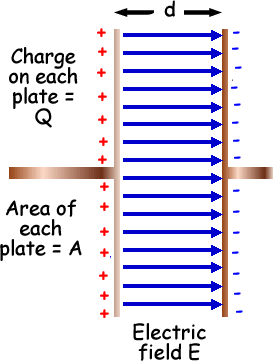
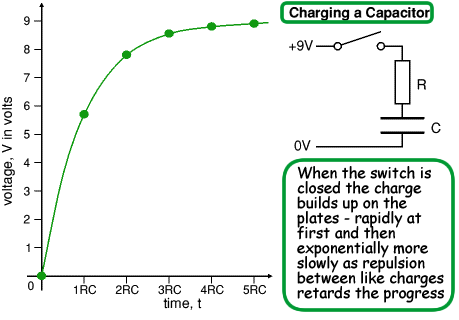
It stores the energy within the electric field between a pair of conductors (called "plates"). The process of storing energy in the capacitor is known as "charging", and involves electric charges of equal size, but opposite charge, building up on each plate.
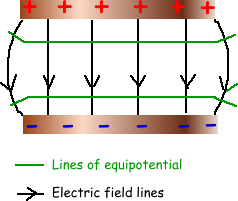
Once charged the plates have a uniformelectric field between them. Within the main body of the plates this field is truly uniform - but at the edges the uniformity is disrupted due to 'edge effects'. Therefore any practical work should take account of this.
Capacitors are often used in electric and electronic circuits as energy-storage devices. There are many different types but in physics questions you are usually asked about a simple parallel plate capacitor. In electronics you will learn about the many types and their uses.
If we connect up circuit A and then close the switch we would observe the bulb lighting up brightly and then getting gradually dimmer until it went out. (This would happen quickly so we would just observe a flash).
This is because the brightness of the bulb will depend upon the size of the current flowing. Initially charge would flow quickly onto the plates of the capacitor (brightly lit bulb) then, as the plates began to fill with charge, the rate of charge flow would exponetially decrease (bulb would grow dimmer) until finally the capacitor would be fully charged and no more charge woul flow (bulb would be dark).
With circuit B, however we would not even notice that the capacitor was there! the bulb would remain lit all of the time. The capacitor would never be fully charged it would be in the process of charging 50 times a second on opposite plates - therefore there would be a good rate of charge transfer (current) to keep the bulb brightly lit up.
The capacitor therefore blocks d.c. current but allows a.c. current through.
Capacitance
The capacitor's capacitance (C) is a measure of the quantity of charge (Q) stored on each plate when a given potential difference or voltage (V) is applied across the plates:

So capacitance is defined as:
The ratio of charge stored on an isolated conductor to the difference in potential.
The charge required to cause unit potential difference in a conductor
Units
In SI units, a capacitor has a capacitance of one farad (F) when one coulomb (C) of charge is stored when one volt (V) of potential difference is applied across the plates. Since the farad is a very large unit, values of capacitors are usually expressed in microfarads ( F), nanofarads (nF), or picofarads (pF).
F), nanofarads (nF), or picofarads (pF).
 Parallel Plate Capacitor
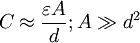
For parallel plate capacitors the capacitance (C) is proportional to the area of each of the conducting plates and inversely proportional to the distance between the plates - as long as the area (A)is much, much greater than the distance between the plates (d) squared.
It is also proportional to the permittivity of the dielectric ( ). The dielectric is the insulator substance that separates the plates - often that is air.
). The dielectric is the insulator substance that separates the plates - often that is air.
The capacitance of a parallel-plate capacitor is therefore given by:
When there is a difference in electric charge between the plates, an electric field is created in the region between the plates. The electric field that created is proportional to the amount of charge that has been moved from one plate to the other. This electric field creates a potential difference V between the plates of this simple parallel-plate capacitor.
V = Ed
Thursday, 12 January 2012
Subscribe to:
Comments (Atom)